
BBQ repeat-order buyer guide
Why BBQ Charcoal Quality Changes Between Containers
Diagnose whether the difference comes from the product, packaging, transport, storage, or test method—then control the next order with a written baseline and order-linked evidence.
6 variation sources12 control pointsPrint / save PDF
The first diagnostic rule
Confirm the difference before explaining the cause.
Buyers often compare one sample tested in a small grill with a later container tested in another appliance, airflow, fuel quantity, or warehouse condition. That can create a real difference in the result without proving a production change.
Start with representative samples and one recorded method. Compare dimensions, mass, condition, useful heat, duration, ash, odor, smoke, cracking, and breakage. Only then investigate which product or supply-chain variable could explain the gap.
Six sources of variation
Quality can change before, during, and after production.
A repeat-order investigation should cover both factory controls and the buyer's own handling and test conditions. Blaming one side before checking the chain is fast, satisfying, and frequently wrong.
Raw charcoal input
Feedstock properties can differ before briquetting begins. Those differences may influence how the final briquette forms and performs.
Ask which incoming-material checks and acceptance rules are used for the product being offered.
Grinding and formulation
Particle distribution, binder, water, mixing, and dosing affect density, strength, ignition, heat behavior, and ash.
Evaluate the finished product against written criteria; do not infer formulation from photographs.
Forming and dimensions
Compaction and dimensions affect unit mass, airflow, surface area, useful heat, duration, packing density, and breakage.
Measure a representative set and link the results to the named sample, lot, and order.
Drying, cooling, and storage
Condition after forming can affect moisture, cracking, strength, ignition, and how the briquette behaves after packing.
Request identified records or tests. A dark, hard-looking briquette is not a moisture measurement.
Packaging and handling
Void space, pack restraint, carton strength, stacking, loading, and repeated handling influence arrival condition and usable yield.
Define acceptable breakage and inspect both product performance and physical condition on arrival.
Buyer test and storage conditions
A different grill, fuel quantity, airflow, endpoint, warehouse, or sample age can make equal products appear different.
Lock the test method and receiving procedure before calling a difference a production failure.
Symptom-to-evidence diagnosis
Investigate the observation—not the supplier's excuse.
The same symptom can have several causes. Use a shortlist of variables and ask for evidence that can distinguish between them.
Dimensions, unit mass, density, moisture condition, airflow, fuel quantity, appliance, and the defined test endpoint.
Dimension and mass check, recorded test setup, interval observations, identified sample or lot, and current specification.
Raw charcoal and formulation variation, briquette mass, test duration, incomplete burn, contamination, or different reporting basis.
Cooled ash weight, photographs at fixed stages, method and basis, retained sample, and an identified test record.
Briquette strength, dimensions, drying condition, inner restraint, carton configuration, stacking, loading, and transport handling.
Packing reference, carton condition, arrival photos, representative breakage count or weight, and loading evidence.
Product condition, lighting method, contamination, storage exposure, airflow, evaluator consistency, and observation window.
Sealed retained sample, repeat test under the baseline method, storage history, and time-stamped observations.
Forming dimensions, cutting, unit mass, pack arrangement, pack count, carton dimensions, or an unapproved format change.
Representative measurement set, approved packaging reference, gross and net weights, and change-control record.
Six-step repeat-order control
Turn the approved sample into a controlled baseline.
Approve an identified reference
Name the product, grade, format, sample date, source, and intended commercial specification. An unlabeled bag is not a baseline.
Separate critical from cosmetic criteria
Define which results can reject the shipment and which are observations. Do this before the first commercial order, not after a complaint.
Lock the test method
Record appliance, fuel quantity, arrangement, lighting, airflow, intervals, start point, endpoint, tending, and environmental notes.
Connect evidence to the order
Ask for records that identify the relevant product, lot, packaging version, date, or commercial order.
Inspect before and after shipment
Review order-linked product and packing evidence, then perform a consistent receiving inspection and retain a sample.
Use change control
If product, process, specification, packaging, or buyer requirements change, review the effect before production or shipment.
Container Consistency Checklist
A full checklist does not prove conformity. Resolve mandatory gaps and evaluate order-linked evidence against the agreed acceptance criteria.
Read production evidence correctly
Photos show activity. They do not certify consistency.
Original photographs are useful when their limits are explicit. Product conformity still requires identified measurements, records, samples, or tests connected to the order.
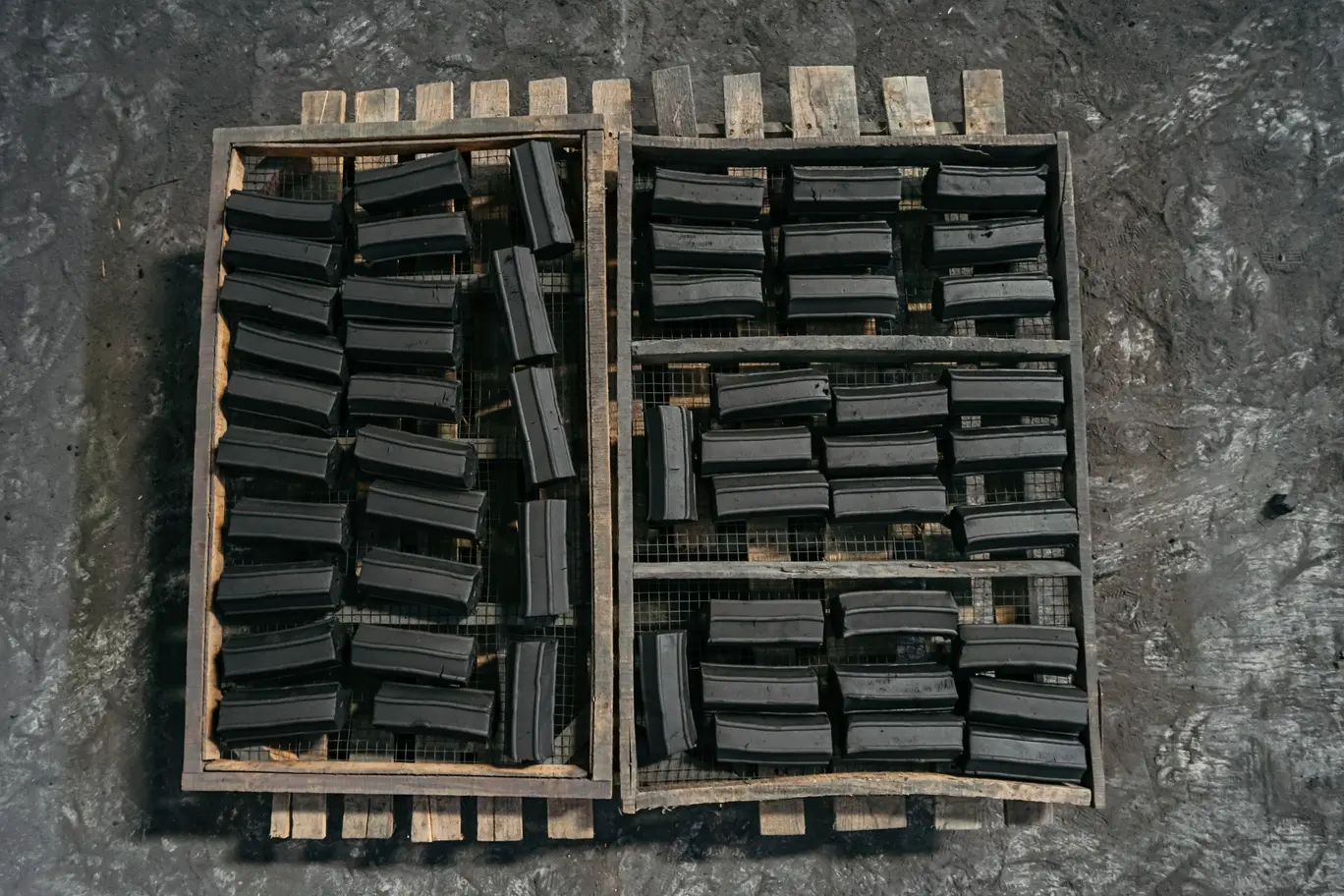
Product form on trays
Proves: The visible elongated briquette form and physical appearance at the photographed production-handling stage.
Does not prove: Verified dimensions, moisture, ash, useful heat, burn duration, strength, or consistency across different lots.
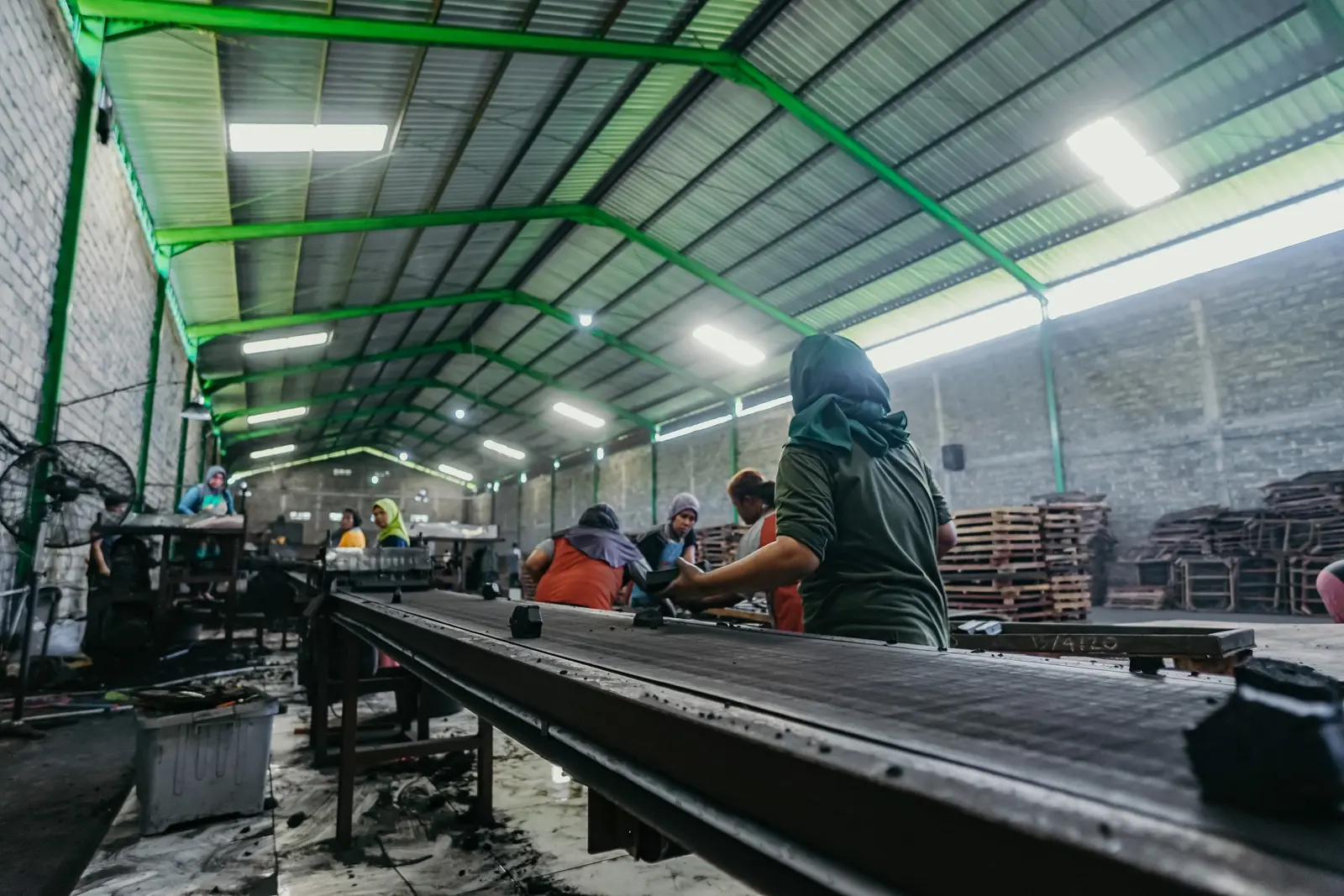
Production-floor handling
Proves: Charcoal briquettes and workers are visible inside the Central Java production facility.
Does not prove: The exact processing stage, formulation, throughput, tolerance, quality result, or order identity.
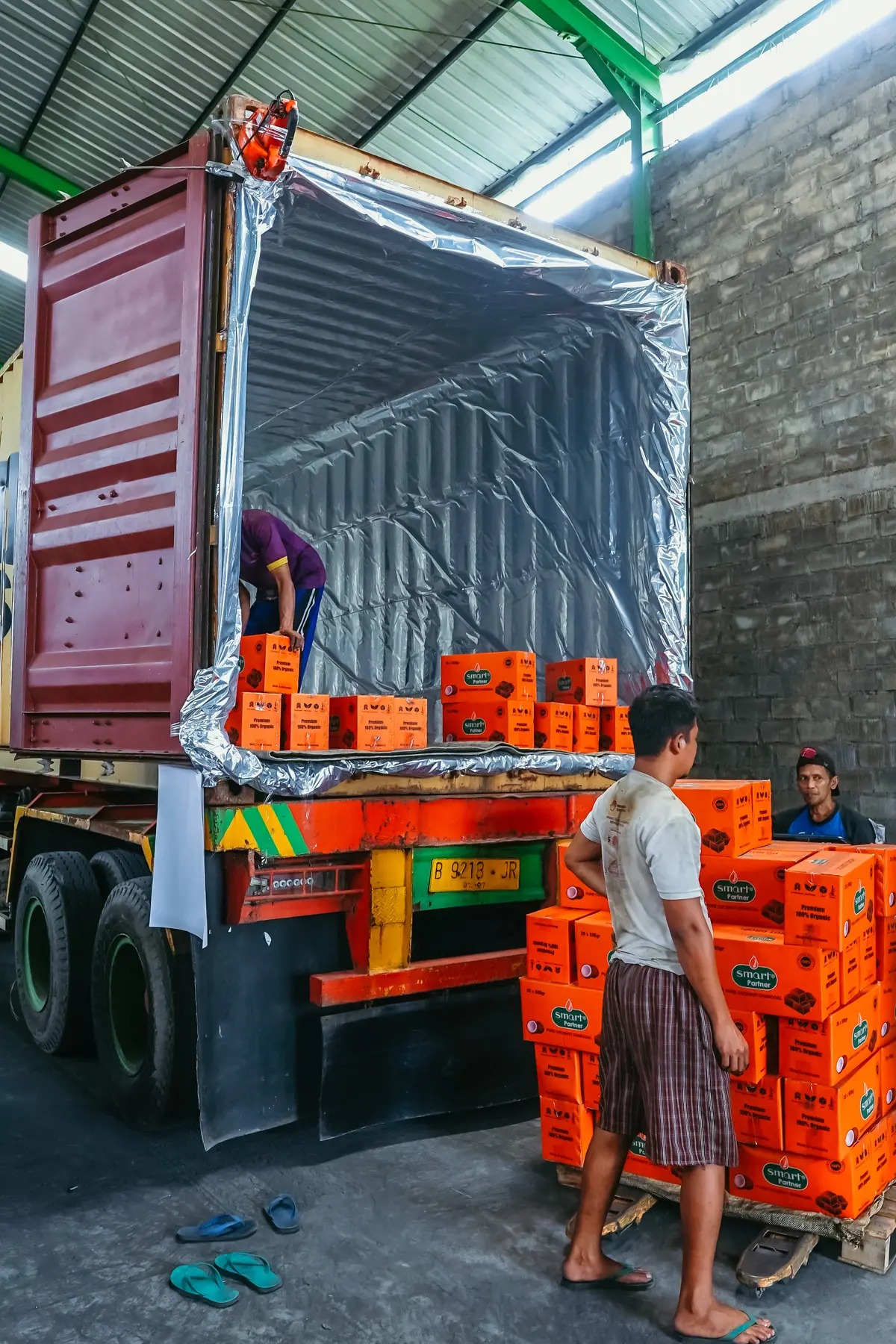
Export container loading
Proves: Printed cartons, a lined container, and active loading are visible at the photographed moment.
Does not prove: The destination, total quantity, product conformity, transit outcome, or repeat-container consistency.
Repeat-order red flags
Six ways a preventable problem becomes “batch variation.”
Most arguments become expensive because the reference, method, evidence, or receiving record was never made clear enough to test either side's claim.
“Natural product” ends the investigation
Natural variation is real, but it is not a substitute for process control, identified records, and corrective action.
Only the quotation is fixed
Price and grade names are recorded, while acceptance criteria, method, packaging, and order-linked evidence remain vague.
The approved sample has no identity
There is no date, grade, format, source, retained piece, written specification, or link to the commercial offer.
Every container uses a new test
Fuel quantity, grill, airflow, endpoint, evaluator, or storage history changes, but the results are treated as directly comparable.
A photo is treated as a laboratory result
Visible product or factory activity is asked to prove moisture, ash, fixed carbon, burn time, strength, or conformity.
A complaint has no receiving evidence
Arrival condition, carton damage, breakage, warehouse exposure, test setup, and retained sample were not documented.
Apply the system with Unimax
Define what stays fixed before the next container.
Start with the current BBQ product, an identified sample, and buyer-critical acceptance criteria.
Unimax can align the available product specification, sample procedure, factory verification, packaging brief, and order-specific evidence with the buyer's sourcing stage. Exact tolerances, test values, loading configuration, and commercial terms are confirmed for the reviewed product and order.
BBQ consistency FAQ
Questions to settle before blaming the next container.
Use the answers as a sourcing framework, then define the exact product, method, and acceptance criteria for the order.
01Is some variation between BBQ charcoal containers normal?+
Some variation can occur in raw inputs, production, storage, packaging, transport, and testing. The procurement question is not whether every piece is identical; it is whether buyer-critical results remain within agreed acceptance criteria under a consistent test method.
02Does an approved sample guarantee the next container?+
No. A sample is useful only when its identity, written specification, test conditions, acceptance criteria, and connection to the commercial order are clear. Repeat-order control also needs order-linked evidence, receiving inspection, retained samples, and change control.
03How should a buyer compare two BBQ charcoal containers?+
Use representative samples and the same appliance, fuel quantity, arrangement, lighting method, airflow, observation intervals, start point, endpoint, tending routine, and evaluator notes. Record physical condition and storage history as well as performance.
04Can a factory photo prove consistent quality?+
No. A photograph can prove visible product, equipment, people, packaging, or activity at a moment in time. It cannot by itself prove invisible specifications or conformity across lots and shipments.
05What should be checked when a container arrives?+
Record container and carton condition, signs of moisture exposure, pack integrity, breakage, representative dimensions and mass, retained samples, and performance under the baseline method. Link observations to the order and receiving date.
06Can Unimax provide a BBQ charcoal sample for evaluation?+
Yes. Product samples are free up to 10 kg. The buyer pays international courier costs. Ask for the current BBQ specification and sample procedure for the destination and format being evaluated.
From complaint to controlled comparison
Build a Repeat-Order BBQ Charcoal Baseline
Share your company, destination, product format, current supplier issue, container or lot being compared, test method, acceptance criteria, and sourcing stage.
Discuss it on WhatsApp