
BBQ charcoal buyer guide
Hexagonal vs Pillow BBQ Charcoal Briquettes
Compare the two shapes by airflow path, fuel-bed arrangement, handling, pack utilization, and market fit. Unimax currently focuses on hexagonal BBQ briquettes—but shape still needs evidence, not mythology.
Center-hole airflowPredictable packingMatched sample test
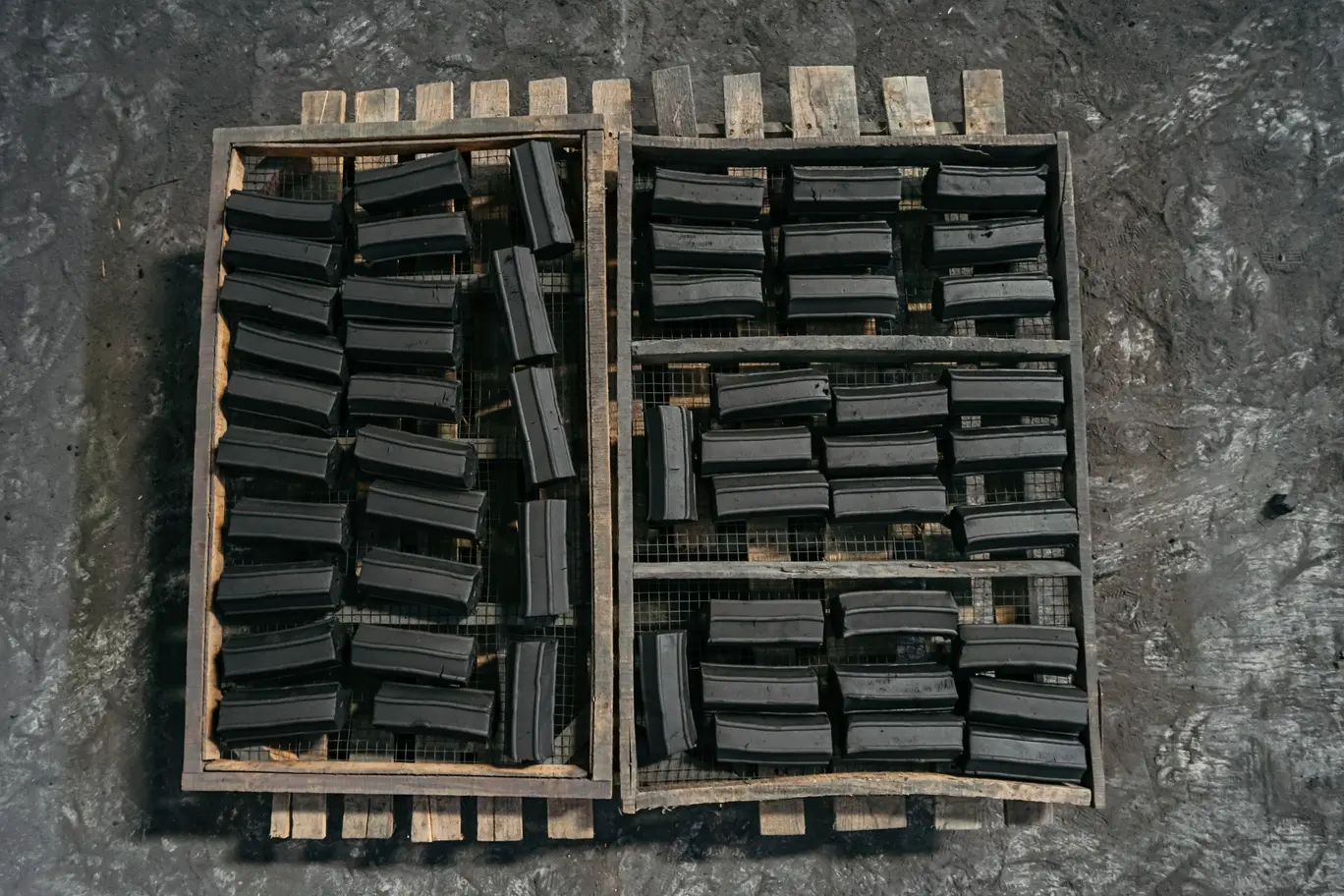
The useful conclusion
Hexagonal is Unimax's main choice. That is a product decision—not a law of physics.
The longitudinal center hole provides another potential air path through the briquette, while the regular profile supports repeatable arranging and more predictable use of pack space. Those are practical reasons Unimax now focuses on hexagonal BBQ briquettes and no longer produces pillow briquettes.
They are not permission to claim automatic superiority. Composition, density, dimensions, unit mass, grill design, airflow setting, ignition, fuel-bed layout, and the test endpoint can outweigh geometry alone.
Side-by-side comparison
Compare what the geometry changes—and what it does not prove.
Use this table to write the sample brief. It is not a substitute for order-specific dimensions, packing data, or a controlled test.
Hexagonal: An elongated, regular cross-section with a longitudinal center hole.
Pillow: A compact rounded or pillow-like piece, commonly without a continuous center channel.
Control: Specify drawings, measuring direction, length, unit mass, and tolerance. Shape names alone are incomplete.
Hexagonal: The center hole adds an internal exposed passage that can support air movement when the hole remains open in the fuel bed.
Pillow: Air mainly moves around the external surfaces and gaps created by the arrangement.
Control: Test in the intended grill. Hole diameter, blockage, stacking, appliance draft, and external airflow all matter.
Hexagonal: Regular pieces can be aligned, spaced, or layered in a repeatable pattern.
Pillow: Rounded pieces tend to settle and rotate, so the gaps can be less predictable.
Control: Photograph the arrangement and keep fuel mass, spacing, bed depth, and tending identical.
Hexagonal: A regular elongated profile can be counted and arranged more predictably inside a defined pack or carton.
Pillow: Irregular contours can leave more variable void space between pieces.
Control: Compare actual packed net weight, carton dimensions, piece count, breakage, and container plan—never shape alone.
Hexagonal: Long pieces and edges require checks for chipping, bending loads, and breakage through packing and transport.
Pillow: Shorter rounded pieces have a different impact and settling pattern, but still require pack-level testing.
Control: Use the same conditioning, drop-test unit, transport route, and damage classification.
Hexagonal: Familiar in many commercial and export BBQ channels, especially where buyers expect elongated briquettes.
Pillow: May be familiar in markets built around pillow-style retail charcoal or specific grill habits.
Control: Validate distributor, restaurant, and end-user expectations in the destination market.
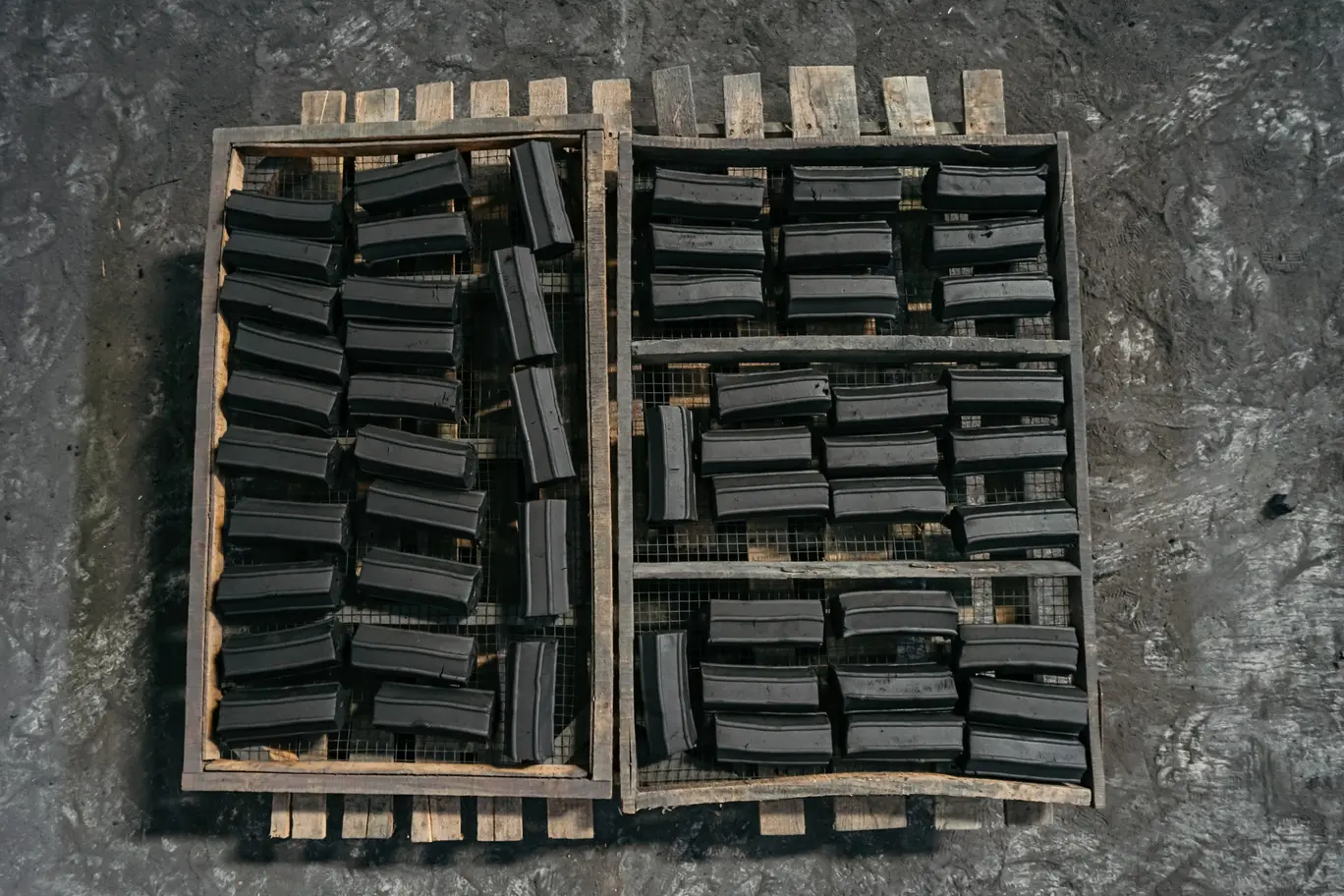
Center hole and airflow
The hole can support airflow only as part of the complete fuel bed.
Additional internal passage
The longitudinal hole exposes an inner surface and creates a possible route for air through the briquette.
Keep the path open
Tight stacking, ash, breakage, or the grill layout can partly block the channel. External gaps still matter.
Measure the system
Record ignition, useful heat, recovery, duration, ash, integrity, and fuel use under the same appliance and airflow conditions.
Six-step buyer method
Choose the shape through the grill, pack, and market—not from a silhouette.
The selected format should survive three filters: operating fit, packed-product economics, and destination-market acceptance.
- 01
Start with the application
Document grill type, grate spacing, airflow control, target heat, service duration, refill practice, and ash-removal workflow.
- 02
Define the physical format
Record cross-section, center-hole diameter where applicable, length, unit mass, tolerances, permitted chips, and pack orientation.
- 03
Compare equal fuel bases
Use equal dry fuel mass or another pre-agreed basis. Equal piece count is often misleading when geometry and unit mass differ.
- 04
Run matched burn tests
Keep appliance, ignition, airflow, arrangement, food load, observation intervals, and useful-heat endpoint the same.
- 05
Validate the final pack
Measure packed net weight, carton dimensions, count, void behavior, fines, breakage, and loading configuration using real production packaging.
- 06
Approve a controlled reference
Connect the selected shape to the sample ID, specification, test method, acceptance criteria, packaging master, and commercial order.
Claims to reject
Four shortcuts that turn geometry into fiction.
Shape can guide the test design. It cannot replace the test result or the loading calculation.
“Center hole means hotter”
Not without matched fuel, density, dimensions, grill, airflow, arrangement, and heat measurements.
“Center hole means longer”
More airflow can also change consumption rate. Duration depends on the complete design and endpoint.
“Hexagonal loads X% more”
Not without actual pack dimensions, net weights, carton pattern, protection, weight limits, and container data.
“Pillow is always outdated”
Market familiarity differs. A buyer should validate channel expectations rather than confuse Unimax's current focus with a universal ban.
Packing efficiency
Regular geometry improves predictability. The carton still decides the number.
Hexagonal pieces can usually be aligned with less variable void space than irregular pillow contours. For procurement, however, “better packing” must become an actual record: briquette dimensions and unit mass, pack count and net weight, inner-pack and carton dimensions, damage allowance, stacking pattern, container type, loading protection, payload, and final carton count.
That evidence can support an order-specific comparison. It does not create a universal container advantage for every hexagonal briquette.
Hexagonal vs pillow FAQ
Questions commercial buyers should settle before choosing a format.
Unimax's current offer is hexagonal. Performance and loading claims still require the exact product, pack, and test evidence.
01Are hexagonal BBQ charcoal briquettes always better than pillow briquettes?+
No. Hexagonal is the current and preferred Unimax BBQ format, but suitability still depends on the grill, target market, product composition, density, dimensions, packaging, and buyer test results. Shape is one design variable, not a universal ranking.
02Does the center hole make hexagonal charcoal burn hotter or longer?+
Not automatically. The hole creates an additional airflow and exposed-surface path, but heat and duration also depend on material, density, cross-section, length, hole diameter, fuel mass, grill draft, arrangement, ignition, and endpoint. Test both candidates under one controlled method.
03Why can hexagonal briquettes pack more predictably?+
Their regular elongated profile can be aligned and counted inside a defined pack, while rounded pillow contours may create more variable voids. The real commercial result must still be verified from pack dimensions, net weight, piece count, breakage protection, carton pattern, and container loading plan.
04How much more charcoal fits in a container with hexagonal briquettes?+
There is no responsible universal percentage. Container payload depends on briquette dimensions and density, pack architecture, carton size and strength, pallet or floor-loading method, weight limits, protection, and the confirmed loading pattern. Ask for order-specific carton and loading data.
05Does Unimax currently produce pillow BBQ briquettes?+
No. Unimax currently focuses on hexagonal BBQ charcoal briquettes and no longer produces pillow briquettes. Buyers should confirm the current grade, dimensions, pack format, specification, sample procedure, and order availability.
06What should a buyer test before approving hexagonal BBQ briquettes?+
Verify geometry and unit mass, then run matched tests for ignition, useful heat, recovery, duration, smoke, odor, sparks, ash, integrity, refill behavior, handling, breakage, pack fit, and loading economics. Connect the result to a traceable sample and written acceptance criteria.
Current Unimax BBQ direction
Discuss a Hexagonal BBQ Charcoal Requirement
Share the destination, target market, grill application, preferred dimensions, pack format, estimated volume, and current supplier issue. Unimax can align the current hexagonal format and sample procedure.
Discuss hexagonal BBQ charcoal