
Importer packaging and logistics guide
How to Calculate BBQ Charcoal Cost per Cooking Hour
Measure the fuel used during a representative service and divide its cost by useful cooking hours. Keep lighting, refills, losses and optional operating costs visible so the comparison can be repeated.
Weighed fuelUseful cooking hoursRecorded operating costs
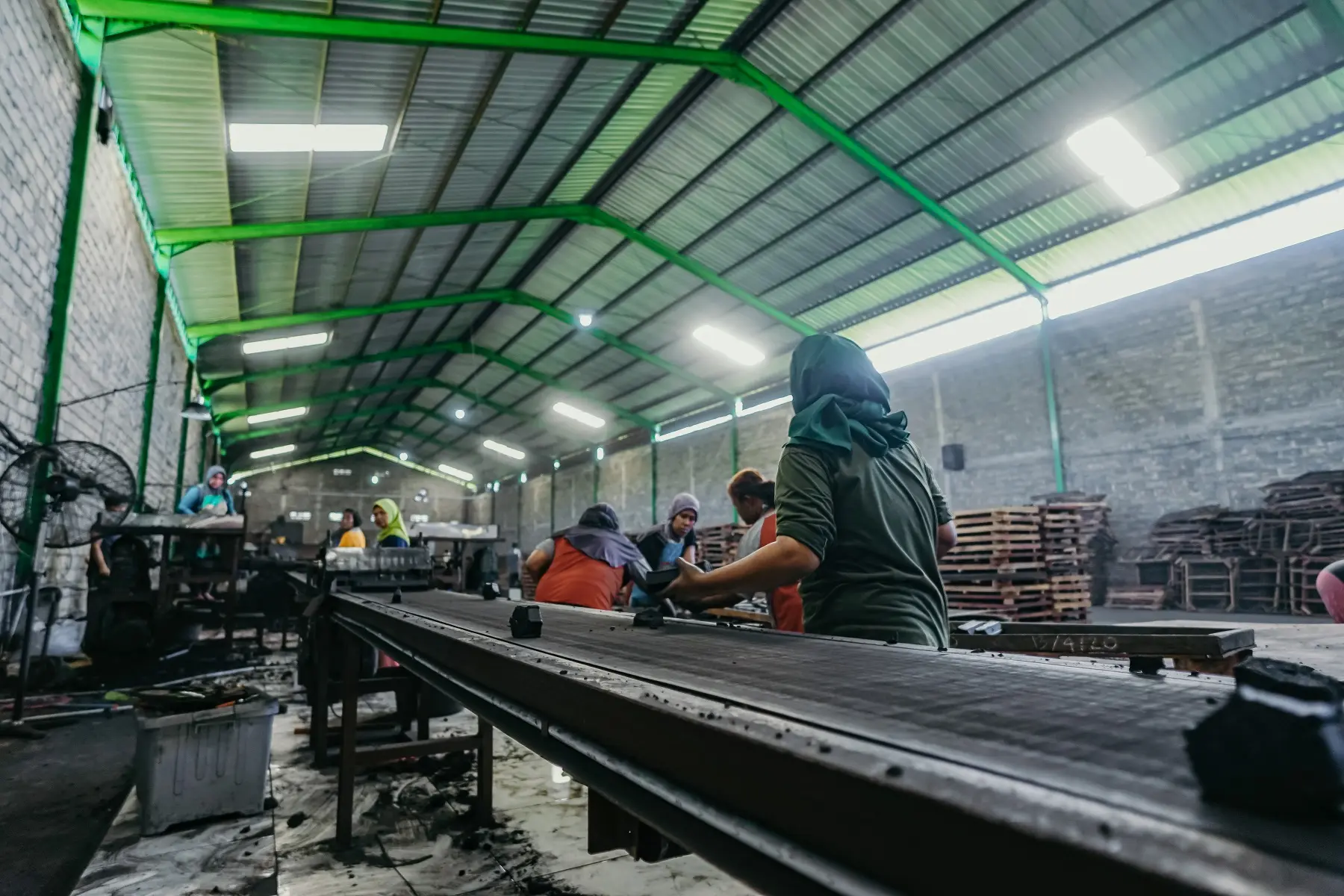
BBQ charcoal cost per cooking hour
Count useful service, not just a glowing ember.
Food-service buyers need fuel that supports the actual cooking task. A long total burn time may include lighting, idle heat or a fading fire that no longer meets the kitchen’s requirement. Those periods should not automatically enter the useful-hours denominator.
Define the grill, task and useful-heat criterion before measuring. Use the usable heat vs total burn time guide to keep the endpoint consistent across products.
The calculation below is an operational worksheet. Results depend on the real grill, fuel handling, airflow, workload and operating method. The example uses invented inputs and generic cost units, not Unimax prices or measured performance.
Usable heat charcoal cost
The fuel-only formula.
Fuel cost per useful cooking hour = session fuel cost ÷ useful cooking hours
Session fuel cost = delivered cost per kg × accountable fuel mass in kg
Accountable fuel mass = initial charge + refills + separately allocated losses not already counted
Use positive useful hours. If the task never meets the useful-heat criterion, report that outcome; dividing by zero does not produce a meaningful hourly cost.
For a simple conservative account, charge all issued fuel to the session and make no leftover credit. If you apply a documented credit for reusable inventory, subtract its allocated value once from session fuel cost and disclose the policy.
Seven inputs to record.
| Input | What to record | Accounting check |
|---|---|---|
| Delivered fuel cost per kg | Use one currency and cost scope from delivery to the chosen receiving point. | Confirm whether losses are already reflected in the cost basis. |
| Initial charge | Weigh the charcoal first issued to the grill. | Record ignition fuel separately only if it is outside this mass. |
| Refills | Sum each additional weighed charge during the session. | Include every top-up; do not count it again as a loss. |
| Additional losses | Record fuel charged to the session but lost outside weighed grill inputs. | Add only losses not already included in initial charge, refills or adjusted cost per kg. |
| Useful cooking hours | Sum periods when the defined cooking task can be performed to the agreed criterion. | Exclude lighting, idle or cooling time that does not meet that criterion. |
| Leftover fuel | Record remaining material, its condition and how the account treats it. | Do not credit all remaining mass as reusable fuel. |
| Optional operating costs | Record measured lighting supplies, labor or cleanup costs separately. | Show fuel-only and expanded totals with the same denominator. |
Delivered fuel cost
Start with a consistent cost per kilogram.
Divide the total cost within your chosen delivery scope by the relevant net charcoal quantity. Use the landed-cost guide to identify included and open items. Record the currency, endpoint and quantity basis.
Keep confirmed and estimated amounts separate. If your unit cost is already calculated per usable kilogram after a loss adjustment, do not add the same loss again to accountable mass. Alternatively, use a received-mass cost basis and allocate separately recorded loss once.
Use one approach for every product being compared. A different accounting basis can change the apparent winner without changing the cooking result.
Fuel mass, refills and lighting
Count the issued fuel once.
Weigh the initial charge and each refill, and keep a simple event log. Charcoal consumed during lighting is already charged if it belongs to the weighed initial batch. Do not add that same mass a second time under “lighting loss.”
If separate charcoal is used for ignition outside those weighed charges, record it as an additional fuel issue. Keep non-charcoal lighting supplies as a separate optional cost rather than treating them as charcoal kilograms.
Record breakage and fines according to the actual use policy. Material still usable in the agreed task is not automatically a loss. Any stock loss allocated to the session must be outside the weighed grill inputs and outside any existing unit-cost adjustment.
Leftover fuel
A remainder is not automatically a credit.
Record remaining material and how it is treated after the service. The simplest comparison charges all issued fuel to the session. This includes fuel left at the endpoint and requires no assumption about later reuse.
If your operation has a documented, appropriate reuse practice, identify the recoverable inventory and its allocated value. Apply a credit once, then carry that inventory and value into the next session consistently. Do not subtract ash, unusable fragments or unverified remaining mass as though it were fresh fuel.
State the policy in the report and use it consistently across products. Follow the equipment and operating instructions for handling and storage; this calculation does not prescribe a recovery procedure.
Worked placeholders
An illustrative service costs 3.50 units per useful hour.
All inputs below are invented for arithmetic only. “Cost units” represent any consistently used currency unit; they are not a market price.
- Delivered cost: 2.00 cost units per kg, on a received-mass basis.
- Initial charge: 4.0 kg; refills: 2.0 kg.
- Separate ignition charcoal outside those charges: 0.5 kg.
- Separately allocated unusable stock loss: 0.5 kg, not included in any earlier quantity or cost adjustment.
- Useful cooking time: 4.0 hours; no leftover credit.
Accountable mass = 4.0 + 2.0 + 0.5 + 0.5 = 7.0 kg
Session fuel cost = 2.00 × 7.0 = 14.00 cost units
Fuel cost per useful hour = 14.00 ÷ 4.0 = 3.50 cost units/hour
If the same accountable cost supported only 3.0 useful hours, the result would be approximately 4.67 units/hour. This sensitivity illustrates why the useful-hours definition matters; it does not predict either outcome for a real product.
Restaurant charcoal operating cost
Show optional costs separately.
To expand the scope, add explicitly recorded lighting-supply, labor and cleanup costs to the session fuel cost, then divide by the same useful cooking hours. Explain whether labor is an allocated operating cost or an incremental cost and keep the approach comparable.
Using the fictional example, add 6.00 units of allocated labor and 2.00 units of cleanup. Expanded session cost is 14.00 + 6.00 + 2.00 = 22.00 units; expanded cost per useful hour is 22.00 ÷ 4.0 = 5.50 units/hour.
Report both results: 3.50 units/hour for fuel only and 5.50 units/hour for the expanded scope. Do not present the expanded total as though it were the charcoal purchase cost, or count a cleanup cost already included elsewhere.
Commercial BBQ fuel cost
Test during a representative service.
Use the restaurant field-trial guide to document comparable equipment and workload.
- 01
Set a representative service
Specify the grill, food task, workload and the useful-heat criterion before testing.
- 02
Confirm the delivered cost basis
Record currency, net quantity and included costs; keep estimates labelled.
- 03
Weigh every fuel issue
Record the initial charge and each refill using the same mass unit.
- 04
Keep a time and event log
Record lighting, useful cooking intervals, refills, interruptions and the endpoint.
- 05
Reconcile losses and leftovers
Separate extra losses from already issued fuel; state any documented leftover credit.
- 06
Repeat and compare totals
Use comparable service conditions and calculate total cost divided by total useful hours across runs.
Compare real services
Keep cost, output and conditions together.
Repeat representative trials and preserve each run’s identity and conditions. For pooled hourly cost, divide total accountable session cost by total useful hours. A simple average of individual hourly rates can be misleading when runs have different durations.
Record cooking output or workload alongside useful hours. Two grills serving different tasks or volumes are not equivalent just because both were hot for four hours. If useful time is recorded per station, state the station-hour basis rather than silently summing simultaneous stations as elapsed time.
Review handling, refills and service interruptions with the food-service evaluation guide. Ask Unimax about the hexagonal coconut BBQ briquette requirement for your application, then validate the result on your own equipment.
Cost-per-hour questions
Can I use total burn time instead of useful cooking hours?
Only time meeting the agreed task criterion belongs in this useful-hour calculation. Record other periods separately.
Should lighting loss be added to the initial charge?
Only if it is an additional fuel issue outside the weighed charge. Fuel already in the initial charge must not be counted twice.
Should leftover fuel always reduce the cost?
No. Use no credit unless a documented recoverable-inventory policy supports it, and disclose that policy.
Does the worked example describe Unimax performance?
No. Every input is fictional. A real result needs measured fuel use, useful hours and the operation’s actual delivered costs.
Measure representative fuel consumption
Bring your grill and service routine into the evaluation.
Share your application, grill, workload and refill routine. Discuss a product and sample plan, then record fuel use and useful cooking time during representative service.